
Market Development: Need Recognition & Market Conditioning
Need Recognition (Category Development)
Need recognition relates to the sophistication of a market, or its "education level", and its stage of development. Clearly, if a market is not able to see the benefits of using a category of product, a brand's demand-generation activities are unlikely to result in much business.
In markets where rational benefits predominate (eg air travel, personal computers and broadband services) the perennial danger is that businesses go to market with the classic "solution looking for a problem". The problem may exist, but unless customers are aware of their need and able to identify potential solutions to it - no sale! (Example)
Customers in many other markets base their preferences less on product features and more on emotional benefits. For example, this occurs with many fashion items such as prestige watches, and in much of the automotive market. Demand is more nascent, and the "market education" process is one of nurturing and drawing out emotional needs which can be linked to the product or service. Similarly, unless the market is sensitised to feel an emotional need for the product, it will fail. | 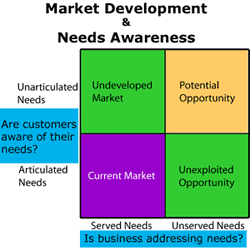 |
Of course, this is a two-sided process. It is a rare vendor which has unswerving clarity on its go-to-market strategy, having fully understood customer needs, preferences, and segmentation from the outset. The need for customer insight is perpetual, but never more so than in during market development activity.
Success comes when vendors correctly anticipate market needs,when customers become more sophisticated in the market space, and vendors keep in step with the level of customer sophistication.
When vendors are able to develop markets in this way they are often able to achieve market leadership. When this is combined with a track record of delivering on brand promises and positive customer experience, a business may be able to build a strong customer franchise.
Demand Generation
Market Development: Need Recognition & Market Conditioning
More Insight